


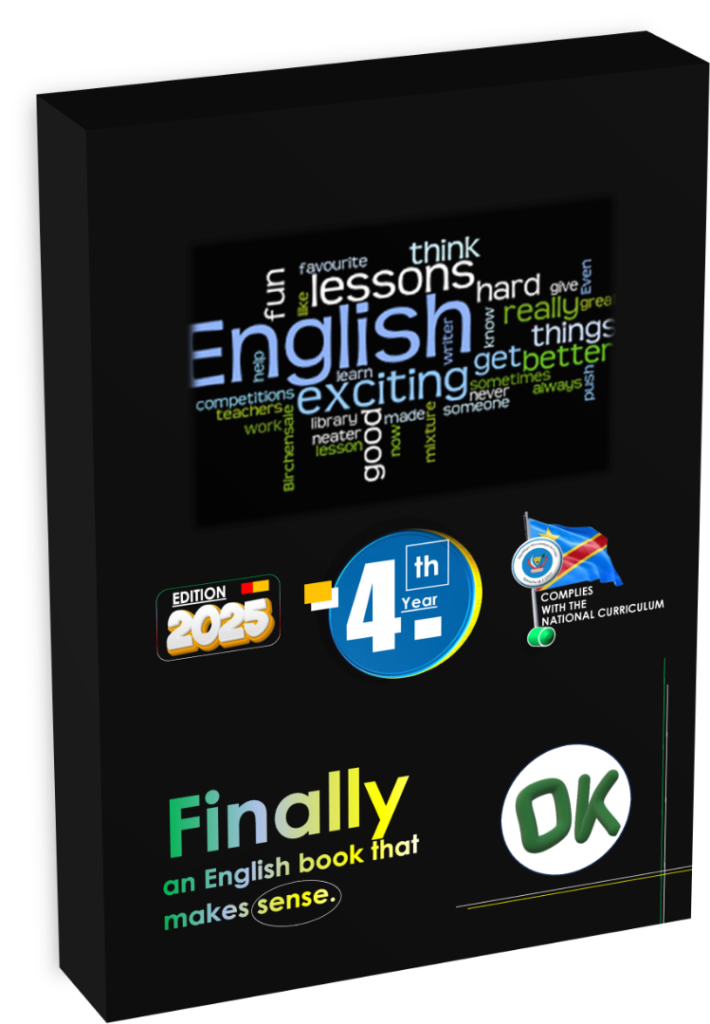
Cours d’Anglais, 4ème Année de l’Enseignement Secondaire en RDC
Edition 2025 / Enseignement primaire, secondaire et technique en RDC
📋 Préliminaires
Objectifs Finaux du Cycle Secondaire : Compétence et Autonomie
This section articulates the ultimate goals of the secondary English curriculum, which culminate in this final year. The primary objective is to transition the student from a guided learner to an autonomous user of the English language. This involves achieving a level of competence that allows for fluid, accurate, and appropriate communication in a variety of academic, social, and pre-professional contexts. The focus is on the confident application of all four language skills—listening, speaking, reading, and writing—to understand and produce complex discourse.
L’Anglais comme Outil d’Insertion Académique et Professionnelle
The orientation of this final year is explicitly pragmatic, positioning English as a vital tool for the student’s future. The curriculum is designed to equip learners with the specific linguistic competencies required for success in higher education, where many reference materials are in English, and for entry into the professional world. The course aims to provide students, whether in major hubs like Kinshasa and Lubumbashi or in other regions, with a competitive advantage for their future academic and economic integration.
Méthodologie de Synthèse et de Production Personnelle
This section outlines the advanced pedagogical approach for the fourth year. The methodology shifts from the acquisition of new structures to their synthesis and application in complex tasks. Learning is driven by the intensive study of authentic texts of various genres (literary, scientific, journalistic). The core activities are centered on personal production: students are expected to analyze, critique, summarize, and create their own structured texts, such as argumentative essays and detailed reports, fostering critical thinking and expressive autonomy.
Préparation à l’Examen d’État et aux Études Supérieures
A key focus of this year is the concrete preparation for the final state examination (Examen d’État) and the transition to university-level studies. The course structure includes systematic revisions, practice with past exam formats, and the development of academic skills like note-taking, summarizing, and oral presentations. The objective is to ensure that students not only master the required content but also develop the methodological rigor and confidence needed to succeed in high-stakes assessments and future academic challenges.
PARTIE I : CONSOLIDATION ET MAÎTRISE DES STRUCTURES (CONSOLIDATION AND MASTERY OF STRUCTURES) 🇬🇧
This inaugural part is dedicated to the in-depth revision and total mastery of complex linguistic structures. The objective is to ensure that the student uses with precision and flexibility the grammatical tools necessary for nuanced and sophisticated expression. The work focuses on the application of these structures in varied contexts, moving from systematic exercises to spontaneous and correct use in oral and written production.
CHAPITRE 1 : TECHNIQUES AVANCÉES DE NARRATION ET DE DISCOURS ✍️
This chapter refines the student’s ability to structure and deliver complex discourse. The goal is to move beyond simple storytelling to a sophisticated manipulation of narrative tools and an awareness of linguistic register, enabling communication that is not only correct but also stylistically appropriate.
1.1. Maîtrise de la Concordance des Temps dans les Récits Complexes
This lesson ensures a complete mastery of the sequence of tenses, particularly in lengthy narratives involving multiple timelines and reported speech. Students will analyze literary extracts to see how authors skillfully navigate between different past tenses (Simple Past, Past Continuous, Past Perfect) to create effects of suspense or flashback, and they will be tasked with producing their own multi-layered narratives.
1.2. Utilisation Stratégique de la Voix Passive et Active
The focus here is on the stylistic choice between the active and passive voice. Students will learn that the passive is not just a grammatical transformation but a tool used to shift focus, create objectivity (common in scientific texts), or maintain topic consistency in a paragraph. They will practice rewriting passages, for instance from a historical account of Kananga, to change the emphasis by switching between voices.
1.3. Le Discours Indirect : Rapporter des Conversations Longues et Complexes
This section moves beyond reporting single sentences to the challenge of reporting entire dialogues or conversations. This involves mastering the nuances of reporting different speech acts (suggestions, warnings, apologies) with a variety of reporting verbs and maintaining tense consistency over long stretches of text, a crucial skill for both academic and professional summaries.
1.4. L’Emploi des Registres de Langue (Formel, Informel, Neutre)
This lesson develops the student’s sociolinguistic awareness. They will learn to identify and use different registers of language appropriate to the context and audience. Activities will involve comparing an informal email between friends with a formal letter of application to a university in Bukavu, and rewriting texts to adapt them from one register to another.
CHAPITRE 2 : L’EXPRESSION DE L’HYPOTHÈSE ET DE LA MODALITÉ 💡
This chapter solidifies the student’s ability to engage in abstract and hypothetical thinking. It focuses on the complete mastery of conditional structures and the subtle meanings of modal verbs, enabling the expression of complex ideas like regret, speculation, and deduction.
2.1. Maîtrise Complète des Phrases Conditionnelles (y compris les formes mixtes)
This lesson consolidates the three basic conditional types and introduces mixed conditionals. Students will learn to use these sophisticated structures to link different time frames, for example, to express the present result of an unreal past condition (« If I had taken your advice, I wouldn’t be in this situation now »).
2.2. Les Nuances des Verbes Modaux au Passé (could have, should have, must have)
Students will master the use of past modals to speculate about or criticize past events. The lesson will clarify the distinct meanings of « should have » (criticism/regret), « could have » (past possibility not taken), and « must have » (logical deduction about the past), applying them to analyze different scenarios.
2.3. Exprimer le Souhait, le Regret et la Préférence (wish, if only, would rather)
This section provides students with a rich toolkit for expressing desires and preferences. They will perfect their use of « wish » and « if only » for regrets and unreal wishes, and learn to use « would rather » to express preference between two or more options, allowing for a more nuanced expression of personal feelings.
2.4. Formuler des Spéculations et des Déductions
This lesson focuses on the language of logical reasoning. Students will learn to use a range of expressions and modal verbs (must, can’t, might, may, could) to express varying degrees of certainty when making deductions about present and past situations, a key skill for critical thinking and analysis.
CHAPITRE 3 : LA SYNTAXE DE LA PHRASE COMPLEXE 🧠
This chapter focuses on the architecture of sophisticated sentences. The objective is to equip students with the ability to construct and deconstruct complex sentences, using a variety of clauses and grammatical devices to create elegant, precise, and stylistically varied prose.
3.1. Maîtrise des Propositions Subordonnées (Relatives, Conjonctives, Infinitives)
This lesson provides a comprehensive review and deepens the understanding of all types of subordinate clauses. Students will focus on advanced relative clauses (e.g., using whose, whom, and prepositional structures), as well as a wide range of adverbial clauses to express complex logical relationships between ideas.
3.2. L’Utilisation Avancée des Gérondifs et des Participes
Moving beyond simple gerund/infinitive patterns, this lesson explores the use of participle clauses (-ing and -ed forms) as a sophisticated technique for combining sentences and adding information concisely. For example, « Feeling tired, he went to bed » instead of « Because he felt tired, he went to bed. »
3.3. Les Phrases Mises en Emphase et les Inversions Stylistiques
Students are introduced to advanced stylistic devices used for emphasis. This includes cleft sentences (« It was the teacher who explained the problem ») and inversion after negative adverbs (« Never before have I seen such a thing »), techniques that add force and elegance to their writing.
3.4. La Ponctuation comme Outil de Clarification et de Style
This final grammar-focused lesson treats punctuation not as a set of rules, but as a tool for creating meaning, clarity, and style. Students will master the use of the semicolon, colon, dash, and parentheses to structure complex sentences and guide the reader, ensuring their written work is both accurate and readable.
PARTIE II : L’ANGLAIS DANS LE CONTEXTE ACADÉMIQUE ET CULTUREL (ENGLISH IN ACADEMIC AND CULTURAL CONTEXTS) 🏛️
This section prepares the student for the use of English as a language of knowledge and culture. The focus is on developing skills essential for higher education and personal enrichment. The student will learn to analyze texts of various kinds (scientific, literary, informational), to synthesize information, and to present it in a structured manner, while opening up to the major themes of the Anglophone world.
CHAPITRE 4 : COMPRÉHENSION ET ANALYSE DE TEXTES 🧐
This chapter is dedicated to developing advanced reading skills, preparing students for the demands of university-level texts. The focus shifts from literal comprehension to critical analysis, interpretation, and evaluation of authentic written materials.
4.1. Stratégies de Lecture Efficace (Skimming, Scanning, In-depth Reading)
This lesson systematizes the reading strategies introduced in previous years. Students will practice applying skimming (reading for gist), scanning (searching for specific information), and in-depth reading (for detailed understanding) to different types of texts and tasks, learning to choose the most efficient strategy for their purpose.
4.2. Analyser des Textes Authentiques (Articles, Essais)
Students will work with unabridged, authentic texts such as newspaper editorials, magazine articles, or short academic essays. The goal is to develop their ability to navigate the complexities of genuine English prose, including sophisticated vocabulary, complex sentence structures, and cultural references.
4.3. Identifier la Thèse, les Arguments et les Exemples
This section introduces the fundamentals of rhetorical analysis. Students will learn to identify the author’s main claim or thesis statement, trace the supporting arguments used to defend it, and evaluate the effectiveness of the examples and evidence provided.
4.4. Distinguer le Fait de l’Opinion
A crucial skill for critical thinking, this lesson focuses on the distinction between objective, verifiable facts and subjective opinions or beliefs. Students will analyze texts to identify and separate factual statements from the author’s personal viewpoints, biases, or interpretations.
CHAPITRE 5 : L’ANGLAIS DE SPÉCIALITÉ (POUR SECTIONS CONCERNÉES) 🔬
This chapter directly addresses the National Curriculum’s requirement to initiate students into the specific vocabulary of their chosen academic stream. The content is designed to be modular, providing a foundation in the English relevant to their future field of study.
5.1. Introduction au Vocabulaire Scientifique et Technique
For students in the Scientifique and Math-Physique sections, this lesson introduces core vocabulary from fields like biology, chemistry, physics, and computer science. The focus is on understanding key terms, processes, and the formal, objective language characteristic of scientific writing. An example could be studying a text about cobalt extraction in the Lualaba province.
5.2. Introduction au Vocabulaire Commercial, Économique et Administratif
For students in the Commerciale et Administrative section, this lesson focuses on the language of business and economics. It covers key terminology related to marketing, finance, management, and international trade, preparing them to understand business reports or economic news from sources like The Financial Times.
5.3. Lire et Comprendre un Document Spécifique à sa Section
In this application-focused lesson, students will read and analyze an authentic document relevant to their field. A science student might read a simplified research abstract, while a literature student analyzes a piece of literary criticism. The goal is to build confidence in tackling the types of texts they will encounter in higher education.
5.4. Rédiger un Compte-Rendu Simple sur un Sujet de Spécialité
As a productive task, students will write a short report or summary (compte-rendu) of the specialized document they studied. This requires them to use the newly acquired vocabulary accurately and to demonstrate their comprehension of the subject matter in a clear, concise, and structured written format.
CHAPITRE 6 : LA SYNTHÈSE ET LA RESTITUTION D’INFORMATION 📝
This chapter focuses on the essential academic skills of processing and presenting information. Students learn how to distill key information from various sources and communicate it effectively, both orally and in writing.
6.1. Techniques de Prise de Notes à partir d’un Texte ou d’un Exposé
This lesson teaches effective note-taking strategies. Students will learn various methods (e.g., Cornell method, mind mapping) to record key information efficiently while reading a text or listening to an oral presentation, moving beyond simple copying to active information processing.
6.2. Rédiger un Résumé Objectif (Summary / Précis)
Building on previous years, this lesson focuses on writing a formal, objective summary (also known as a précis). The emphasis is on conciseness, accuracy, and neutrality, requiring students to report the source’s main ideas without interjecting their own opinions.
6.3. Préparer et Faire un Exposé Oral Structuré
This section develops public speaking skills. Students learn the entire process of preparing and delivering a structured oral presentation, from researching a topic and creating an outline to designing visual aids and managing their time effectively during delivery.
6.4. Participer à une Table Ronde ou un Séminaire
This culminating activity simulates a university seminar or a professional round table. A group of students will present on a topic, after which the rest of the class, guided by the teacher, will ask questions and engage in a structured discussion. This practices active listening, critical questioning, and spontaneous oral expression in a formal setting.
PARTIE III : LITTÉRATURE, ARTS ET ESPRIT CRITIQUE (LITERATURE, ARTS, AND CRITICAL THINKING) 🎭
This third part constitutes an immersion in the anglophone cultural and literary universe, aimed at developing the student’s critical thinking and aesthetic sensitivity. Through the study of significant works and texts, the student learns to interpret, analyze, and formulate a personal and argued judgment, thereby mobilizing all their linguistic skills in the service of in-depth reflection.
CHAPITRE 7 : ANALYSE LITTÉRAIRE : LA PROSE 📖
This chapter deepens the students’ engagement with prose fiction, moving from basic comprehension to genuine literary analysis. The selection of texts will reflect the curriculum’s recommendation to include English, American, and African authors.
7.1. Étude d’Extraits de Romans ou de Nouvelles (Auteurs Anglais, Américains, Africains)
Students will engage in the close reading of substantial extracts from major works of Anglophone literature. The selection could include a passage from a novel by an author like Chinua Achebe to explore post-colonial themes, or Charles Dickens to understand social commentary in 19th-century England, as suggested by the national programme.
7.2. L’Analyse des Personnages, du Cadre et de l’Intrigue
This lesson equips students with the tools for formal literary analysis. They will learn to analyze character development (static vs. dynamic characters), the role of the setting in creating mood and atmosphere, and the structure of the plot (exposition, rising action, climax, resolution).
7.3. Identifier les Thèmes et le Point de Vue Narratif
Students will move to a more abstract level of analysis, identifying the central themes or main ideas of the text. They will also analyze the narrative point of view (first-person, third-person omniscient, etc.) and discuss how the choice of narrator affects the reader’s understanding of the story.
7.4. Rédiger un Commentaire de Texte Guidé
As a culminating task, students will write a guided literary commentary on the extract studied. They will be required to formulate a thesis statement about the text and support it with specific evidence and quotations, demonstrating their ability to construct a coherent analytical argument in writing.
CHAPITRE 8 : ANALYSE LITTÉRAIRE : POÉSIE ET THÉÂTRE 📜
This chapter expands the students’ literary horizons to include poetry and drama. The focus is on understanding the specific conventions and linguistic features of these genres and appreciating their unique power to convey meaning and emotion.
8.1. Étude de Poèmes et Analyse des Figures de Style
Students will analyze selected poems, focusing on identifying and interpreting key figurative language such as metaphors, similes, and personification. They will also discuss the effects of sound devices (alliteration, assonance) and rhythm, exploring how the form of a poem contributes to its meaning.
8.2. Étude d’une Scène de Théâtre et Analyse du Dialogue
The class will read and analyze a key scene from an Anglophone play, possibly a short excerpt from an author like Shakespeare or a modern playwright. The analysis will focus on dialogue, subtext (what is meant but not said), stage directions, and conflict between characters.
8.3. Comprendre et Discuter du Langage Poétique et Dramatique
This lesson encourages students to reflect on the unique qualities of poetic and dramatic language. They will discuss how these genres use language more compressedly and evocatively than prose to create powerful emotional and intellectual impacts on the audience or reader.
8.4. Comparer Différents Textes sur un Même Thème
To develop their synthetic and critical skills, students will be asked to compare two or three different texts (e.g., a poem, a play extract, a short story) that deal with a similar theme, such as love, war, or justice. They will analyze how each genre treats the theme differently, showcasing their analytical maturity.
CHAPITRE 9 : L’ARGUMENTATION ET L’ESSAI CRITIQUE ✒️
This chapter focuses on the pinnacle of academic writing: the argumentative essay or dissertation. It synthesizes the skills of critical analysis and structured writing, preparing students for the primary mode of assessment in many university humanities courses.
9.1. Les Caractéristiques de l’Essai Argumentatif (Dissertation)
This lesson defines the key features of an argumentative essay. Students will learn that its purpose is to persuade the reader of a particular point of view (the thesis) through logical reasoning and evidence. The importance of a clear, debatable thesis statement is emphasized.
9.2. Construire une Problématique et un Plan Détaillé
Students learn how to move from a general topic to a specific research question or problématique. They will then practice creating a detailed outline (plan) for their essay, organizing their arguments into a logical sequence of introduction, body paragraphs, and conclusion.
9.3. Développer ses Arguments avec des Exemples Pertinents
This section focuses on the body of the essay. Students learn that each paragraph should focus on a single idea, introduced by a topic sentence, and that all claims must be supported with relevant evidence and examples, whether from a literary text or other sources.
9.4. Utiliser les Mots de Liaison pour Assurer la Cohérence du Discours
The final lesson on essay writing focuses on cohesion. Students will master a wide range of transition words and phrases (connectors) to link their ideas smoothly, ensuring that their essay flows logically and is easy for the reader to follow from one point to the next.
PARTIE IV : PRÉPARATION À L’AVENIR (PREPARING FOR THE FUTURE) 🚀
The last part of the year is resolutely focused on the final consolidation of achievements and concrete preparation for end-of-cycle deadlines and beyond. It aims to systematize revisions, familiarize the student with the format of certification tests, and provide them with the necessary linguistic tools for their future endeavors, whether academic or professional.
CHAPITRE 10 : LA COMMUNICATION PROFESSIONNELLE 💼
This chapter provides students with practical, real-world English skills for entering the job market or applying for further education. The focus is on the specific conventions and language required in professional contexts.
10.1. Rédiger une Lettre de Motivation (Cover Letter)
Students will learn the structure, format, and appropriate formal tone for a cover letter. They will analyze models and practice writing their own letters, for example, applying for a fictional internship at a major company or NGO based in Kinshasa.
10.2. Élaborer un Curriculum Vitae (CV) en Anglais
This lesson teaches the conventions of writing a standard Curriculum Vitae in English. Students will learn how to present their personal details, education, work experience (if any), and skills in a clear, concise, and professional format suitable for international applications.
10.3. Simuler un Entretien d’Embauche ou d’Admission
This highly interactive lesson prepares students for the pressure of a formal interview. They will practice answering common interview questions, learn how to present themselves positively, and ask appropriate questions of their own. The class will conduct mock interviews to build confidence.
10.4. L’Anglais dans les Situations Professionnelles Courantes (Téléphone, Réunions)
This section covers essential functional language for the workplace. It includes key phrases for professional telephone conversations, participating in meetings (e.g., agreeing, disagreeing, making suggestions), and writing professional emails, providing a solid foundation for future professional communication.
CHAPITRE 11 : SYNTHÈSE ET RÉVISION SYSTÉMATIQUE 📚
This chapter is dedicated to a strategic and comprehensive review of the entire secondary English curriculum. The goal is to identify and reinforce areas of weakness and ensure that all students have a solid command of the core vocabulary and grammar before the final exams.
11.1. Révision Systématique du Vocabulaire des Quatre Années
This lesson involves a systematic review of the 2,000-word target vocabulary. The review will be organized thematically, using quizzes, games, and contextual exercises to reactivate and consolidate the students’ lexicon from all four years of study.
11.2. Révision des Points de Grammaire Clés et des Difficultés Courantes
The teacher will guide students through a review of the most important and challenging grammatical structures covered in the secondary cycle, such as conditional sentences, reported speech, and the use of articles. The focus will be on addressing common errors and clarifying persistent points of confusion.
11.3. Exercices de Traduction (Thème et Version) sur des Textes de Synthèse
As suggested by the national curriculum for advanced levels, this lesson uses translation as a tool for linguistic analysis. Students will work on short, complex texts, translating from English to French (version) and from French to English (thème) to test their precise understanding of syntax, vocabulary, and idiomatic expressions.
11.4. Ateliers de Correction et d’Amélioration de l’Expression Écrite
This lesson takes the form of a writing workshop. Students will bring their own written work (essays, summaries) and, through peer review and teacher feedback, will learn to identify their own weaknesses and practice techniques for improving clarity, coherence, and grammatical accuracy.
CHAPITRE 12 : PRÉPARATION INTENSIVE À L’EXAMEN D’ÉTAT 🎓
This final chapter is entirely focused on preparing students for the specific format and demands of the English paper in the Examen d’État. The objective is to demystify the exam, build confidence, and develop effective test-taking strategies.
12.1. Analyse de la Structure des Épreuves d’Anglais des Années Précédentes
The teacher will provide students with past papers from the state exam. The first step is a thorough analysis of the exam’s structure: the types of questions asked, the skills tested in each section, the time allotted, and the marking scheme.
12.2. Examen Blanc en Conditions Réelles : Compréhension à l’Écrit (Reading Comprehension)
Students will complete the Reading Comprehension section of a past paper under timed, exam-like conditions. The subsequent correction will focus on strategies for reading efficiently and answering different question types (e.g., multiple choice, open-ended questions, vocabulary questions).
12.3. Examen Blanc en Conditions Réelles : Compétence Linguistique (Language Competence)
This session focuses on the Language Competence or grammar section of the exam. After completing the section under timed conditions, the review will focus on common pitfalls and techniques for quickly and accurately solving exercises on verb tenses, prepositions, and other structural points.
12.4. Examen Blanc en Conditions Réelles : Production Écrite (Writing)
Finally, students will tackle the Writing section, which is often a composition or essay. They will practice planning and writing a complete essay within the time limit. The correction will focus on structure, argumentation, clarity of expression, and grammatical accuracy, ensuring they are fully prepared for this crucial part of the exam.
📚 Annexes
ANNEXE 1 : Lexique de Vocabulaire Spécialisé (par grande section d’études)
This appendix provides a valuable resource tailored to the students’ specific academic streams, as mandated by the national curriculum. It contains thematic glossaries of essential English vocabulary for major fields: Science and Mathematics, Commerce and Administration, and Literature/Pedagogy. This tool is designed to support the work in Chapter 5 and to serve as a reference for students as they transition to higher education in their chosen fields.
ANNEXE 2 : Guide Méthodologique de la Dissertation et du Commentaire de Texte
This section offers a detailed, step-by-step guide to the two most important forms of academic writing covered in the final year. It provides templates, checklists, and examples for structuring a literary commentary and an argumentative essay. This guide serves as a practical tool that students can consult when preparing written assignments and revising for the state exam.
ANNEXE 3 : Annales Corrigées de l’Examen d’État et Conseils Pratiques
This final appendix provides a crucial resource for exam preparation. It contains a selection of complete past papers from the Examen d’État with detailed answer keys and explanations. It also includes a section of practical advice and test-taking strategies, such as time management, how to approach different question types, and tips for avoiding common errors, offering a final boost of confidence before the examination.
Discussion (0)
Aucune intervention pour le moment. Soyez le premier à contribuer.
Votre intervention Annuler la réponse