



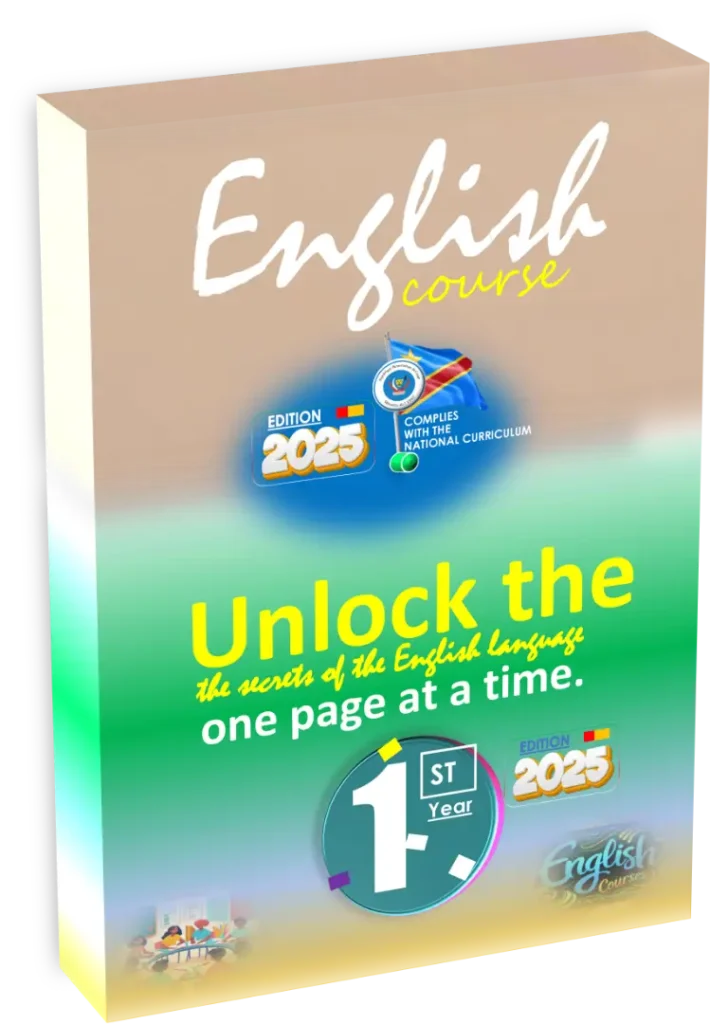
Cours d’Anglais, 1ère Année de l’Enseignement Secondaire en RDC
Edition 2025 / Enseignement primaire, secondaire et technique en RDC
📋 Préliminaires
Introduction Générale
This section establishes the foundational philosophy of the English language course for the Congolese secondary cycle. It explains that English is presented not merely as a subject, but as an essential tool for communication in an increasingly interconnected world. The manual is designed in strict adherence to the National Programme, with the ultimate aim of equipping pupils with practical linguistic skills. This course aims to empower students from all corners of the DRC, from the bustling markets of Kinshasa to the copper mines of Lubumbashi, to engage confidently with the wider Anglophone world.
Objectifs du Cours d’Anglais en 1ère Année Secondaire
The specific, measurable goals for this inaugural year of secondary English are explicitly defined here. By the end of this year, pupils are expected to understand, speak, read, and write English at a basic level. The primary focus during this first stage is on acquiring spoken language proficiency. Pupils will learn to hold a simple conversation, read basic texts, and write a simple letter or message. The curriculum sets a concrete target for pupils to acquire an active vocabulary of approximately 500 words.
Approche Pédagogique et Méthodologie
This section details the modern teaching principles that underpin the entire course. The methodology follows a rigorous and progressive order: listening, understanding, speaking, reading, and finally, writing. The course explicitly rejects traditional, deductive grammar teaching and the excessive use of translation. Instead, it mandates an inductive approach where grammatical structures are introduced progressively from simple to complex and always within a meaningful context. Oral practice, through individual, group, and collective repetition, is considered a necessity to ensure correct pronunciation and intonation.
Structure du Manuel et Guide d’Utilisation
A clear guide for the teacher on how to navigate the manual is provided in this section. It explains the logical division of the content into four main parts and twelve chapters, each building upon the last. The guide offers practical advice on lesson planning, emphasizing the importance of visual aids like images and wall charts, as well as auditory tools like audio recordings, to create a natural and effective learning environment. It details how each chapter is structured with clear presentations, oral drills (« pattern drills »), communicative activities, and revision exercises to facilitate the contextualization and mastery of new structures.
PARTIE I : LES BASES DE LA COMMUNICATION (LAYING THE FOUNDATIONS) 🇬🇧
This inaugural part establishes the essential foundation for communicative competence. It is methodically designed to equip the pupil with the fundamental linguistic tools for basic interaction, focusing on greetings, introductions, and the identification of people and objects in the immediate environment. The emphasis is overwhelmingly on oral skills, correct pronunciation, and the mastery of core grammatical structures like the verb « to be » and demonstratives, enabling simple yet accurate communication from the very first lesson.
CHAPITRE 1 : PREMIERS CONTACTS (FIRST CONTACTS) 👋
This chapter serves as the entry point into the English language, focusing on the most immediate and essential functions of social interaction: meeting and greeting people. Pupils will learn and practice the basic formulas necessary to initiate a conversation, present themselves, and inquire about others in a polite and clear manner.
1.1. Salutations et Formules de Politesse (Greetings and Courtesy Formulas)
This section introduces the essential vocabulary for social courtesy. Pupils will learn fundamental greetings like « Hello » and polite expressions such as « Yes, please » and « No, thank you ». The lesson also covers conventional formulas for leave-taking, like « Good-bye », and expressions of apology such as « I’m sorry » and « Excuse me ». These are practiced through role-playing simple scenarios, for instance, a pupil entering a shop in Kananga.
1.2. Se Présenter et Présenter Quelqu’un (Introducing Oneself and Others)
Here, learners acquire the structures needed to state their name and introduce other people. The core phrases « My name is… » and « Here is Miss Banda » are extensively practiced. They will also learn appropriate responses to an introduction, such as « How do you do? » and « I’m glad to meet you ». The objective is to enable pupils to confidently manage a simple, formal introduction.
1.3. L’Alphabet et l’Épellation (The Alphabet and Spelling)
Mastery of the English alphabet is the central focus of this section, as mandated by the national curriculum. Pupils will learn to recognize, pronounce, and write all 26 letters. The primary communicative skill developed is oral spelling, allowing them to ask for and provide the spelling of names and other words, a crucial skill for clarification in any conversation.
1.4. Les Nombres Cardinaux (1-100) et l’Âge (Cardinal Numbers and Age)
This lesson equips pupils with the ability to count and use numbers from one to one hundred. This numerical literacy is immediately applied to the practical and personal context of stating one’s age. They will learn to ask the question « How old are you? » and to answer with the structure « I am fourteen years old ». Practice involves pupils surveying their classmates’ ages.
CHAPITRE 2 : MON ENVIRONNEMENT SCOLAIRE (MY SCHOOL ENVIRONMENT) 🏫
This chapter grounds the learning process in the pupil’s most familiar setting: the classroom. By learning to name and identify objects around them, pupils directly link English vocabulary to tangible items, which strongly reinforces memory and comprehension. The chapter introduces fundamental grammar for identification and questioning.
2.1. Identifier les Objets de la Classe (Identifying Classroom Objects)
The core of this section is the acquisition of essential classroom vocabulary. Pupils will learn the English terms for common items such as « pen, » « pencil, » « book, » and « orange ». Learning is facilitated through the direct use of real objects and visual aids within the classroom, effectively turning a school in Bukavu into a dynamic language-learning laboratory.
2.2. L’Article Indéfini : « a » / « an » (The Indefinite Article)
Building on the new vocabulary, this lesson introduces the indefinite articles « a » and « an ». The rule governing their use— »a » before a consonant sound and « an » before a vowel sound—is demonstrated through clear, repetitive examples (« a pen, » « an orange »). Pupils practice this distinction through structured drills where they must select the correct article for various objects.
2.3. Les Démonstratifs Singuliers : « this » / « that » (Singular Demonstratives)
This section teaches pupils how to identify and point out singular objects using « this » for items that are near and « that » for items that are at a distance. The distinction is made tangible through physical demonstration. Structured practice involves sentence patterns like « This is a book » and « That is a pencil ».
2.4. Poser des Questions avec « What » (Asking Questions with « What »)
Pupils learn how to formulate the fundamental question for identifying objects: « What is this? » or « What is that?« . They also master the standard answer structure, « It is a pen ». The lesson is built around interactive question-and-answer drills where pupils practice identifying objects held by the teacher or their peers.
CHAPITRE 3 : LES PERSONNES AUTOUR DE MOI (PEOPLE AROUND ME) 👨👩👧👦
This chapter transitions the focus from inanimate objects to people, enabling pupils to identify and make simple statements about their classmates, teachers, and family members. The verb « to be » is the central grammatical pillar of this chapter, providing the essential structure for all basic identification and description in English.
3.1. Le Verbe « to be » : Formes Affirmative et Négative (The Verb « to be »: Affirmative and Negative Forms)
This section systematically introduces the present simple of the verb « to be » (am, is, are) in its affirmative forms. Pupils learn to create sentences like « I am a pupil » or « He is a teacher ». Subsequently, the negative forms are presented using « not » (e.g., « This is not Mr Mengi »). The practice involves making true statements about people in the classroom.
3.2. Le Verbe « to be » : Forme Interrogative et Réponses Courtes (The Verb « to be »: Interrogative Form and Short Answers)
Here, learners master asking yes/no questions by inverting the subject and the verb « to be, » for example, « Is that Mr. Mengi? » or « Are you a teacher? ». A key focus is on providing grammatically correct short answers (« Yes, it is. » / « No, he is not. »), which are a fundamental feature of natural English dialogue.
3.3. Les Pronoms Personnels Sujets (Subject Pronouns)
The subject pronouns (I, you, he, she, it, we, they) are presented and linked to their function of replacing nouns to avoid repetition. Pupils practice substituting names with the appropriate pronoun, for instance, changing « Mr Mengi is a teacher » to « He is a teacher ». This is essential for creating more fluid and natural-sounding sentences.
3.4. Identifier les Personnes avec « Who » (Identifying People with « Who »)
To complete the focus on identifying people, pupils learn to ask questions with the interrogative pronoun « Who, » as in « Who is this? ». They practice answering with structures like « This is Mr Mengi ». This skill is contextualized through activities like looking at photographs and identifying the individuals shown, for example, family members or famous people from the DRC.
PARTIE II : DÉCRIRE LE MONDE QUI NOUS ENTOURE (DESCRIBING THE WORLD AROUND US) 🌍
Building on the foundational skills of Part I, this section equips the learner to move beyond simple identification and begin to describe the world in greater detail. The introduction of adjectives, plurals, and possessive structures allows pupils to qualify objects, express ownership, and talk about groups of things. The grammar is progressively layered to enable the construction of richer, more precise sentences, thereby significantly enhancing the learner’s descriptive capabilities.
CHAPITRE 4 : LE MONDE EN COULEURS (THE WORLD IN COLOURS) 🎨
This chapter enriches the pupil’s descriptive toolkit, enabling them to talk about multiple objects and specify their characteristics, such as color and quality. It introduces the concepts of plurality and qualification, which are essential for creating more detailed and accurate descriptions of their environment.
4.1. Les Pluriels Réguliers et Irréguliers des Noms (Regular and Irregular Noun Plurals)
This section teaches the standard rule for forming the plural of nouns by adding « -s » or « -es » (e.g., « pens, » « oranges »). The curriculum also specifies that the spelling of some « irregular » noun plurals should be covered, so pupils will be introduced to common examples like « man/men » and « child/children. »
4.2. Les Démonstratifs Pluriels : « these » / « those » (Plural Demonstratives)
As a logical progression from « this » and « that, » pupils learn their plural counterparts: « these » for pointing out multiple items nearby, and « those » for multiple items at a distance. The structure is practiced with sentences like « These are pens » and « Those are oranges ».
4.3. Les Adjectifs Qualificatifs et les Couleurs (Qualifying Adjectives and Colours)
A foundational set of descriptive adjectives is introduced, focusing on basic qualities (« new, » « old, » « big ») and colors (« blue, » « red, » « green »). Pupils learn this vocabulary by describing real objects in their surroundings, for example, the color of their pens or the size of their books. The structure is « This pen is blue ».
4.4. La Place de l’Adjectif dans la Phrase (The Position of the Adjective)
A fundamental rule of English syntax is explicitly taught: the adjective is placed before the noun it modifies. This is a crucial difference from French syntax. Pupils practice this rule by building noun phrases, transforming « a book » and « blue » into « a blue book ». This is applied to a variety of objects, for example describing produce at a market in Mbandaka.
CHAPITRE 5 : LA POSSESSION (POSSESSION) 🎁
This chapter introduces the various ways to express ownership and belonging in English. Pupils will learn how to talk about their own possessions and to describe relationships between people and their belongings, a critical step for personalizing their speech.
5.1. Les Adjectifs Possessifs (Possessive Adjectives)
The possessive adjectives (« my, » « your, » « his, » « her, » « its, » « our, » « their« ) are systematically presented. Pupils learn to use these adjectives before a noun to indicate ownership, as shown in the curriculum structure « my (your/his, etc.) pen ». They practice by identifying objects in the classroom, saying, for example, « This is my book » and « That is her pen. »
5.2. Le Cas Possessif : Génitif Saxon (‘s) (The Possessive Case: Saxon Genitive)
Pupils learn to express possession using the Saxon Genitive (‘s) for people and sometimes animals. The structure is explained with examples such as « My brother’s name » or « Mr Songolo’s pens ». This allows for more precise statements about who owns what, for instance, « This is the teacher’s chair. »
5.3. Le Verbe « to have got » : Formes Affirmative, Négative et Interrogative (The Verb « to have got »)
The verb « have got » is introduced as a common way to talk about possession. The curriculum presents the structure « Who has got a pen? » although instruction will cover all forms: affirmative (« I have got a new book »), negative (« He has not got a bicycle »), and interrogative (« Have you got a sister? »).
5.4. Les Pronoms Possessifs (Possessive Pronouns: mine, yours, etc.)
To complete the topic of possession, pupils learn about possessive pronouns (« mine, » « yours, » « his, » « hers, » « ours, » « theirs« ). The key teaching point is that these pronouns replace a possessive adjective + noun to avoid repetition. For example, instead of « This book is my book, » the pupil learns to say « This book is mine. » The question « Whose pen is this? » is used to elicit the use of these pronouns.
CHAPITRE 6 : SITUER DANS L’ESPACE (LOCATING IN SPACE) 📍
This chapter focuses on developing the pupil’s ability to describe the location of people and objects in space. It provides the essential linguistic tools for answering the question « Where? » and for making basic comparisons between items in their environment.
6.1. La Structure « There is » / « There are » (The Structure « There is » / « There are »)
Pupils learn to use « There is » for singular nouns and « There are » for plural nouns to state the existence of something. This is fundamental for describing any scene or location. A pupil from Kolwezi could describe their classroom: « There is a board, and there are thirty desks. » The negative and interrogative forms (« Is there…? » / « Are there…? ») are also systematically taught.
6.2. Les Prépositions de Lieu Fondamentales : « in », « on », « at », « under » (Basic Prepositions of Place)
This section introduces the most common prepositions of place. The curriculum provides examples using « in » and « on« . The lesson will expand to include « at » and « under, » demonstrating their meanings physically and visually. Pupils practice by describing locations of objects, for example, « My pen is in the classroom » or « The book is on the desk ».
6.3. Poser des Questions avec « Where » (Asking Questions with « Where »)
Learners are taught to ask about the location of objects or people using the question word « Where?« . They practice combining this question with the verb « to be » in its present (« is/are ») and past (« was/were ») forms, as shown in the curriculum. A typical exchange would be: « Where is my book? » « It is on the desk. »
6.4. Les Comparatifs de Supériorité (Adjectifs Courts) (Comparatives of Superiority – Short Adjectives)
An introduction to making comparisons is provided, focusing on short (one-syllable) adjectives. Pupils learn to form the comparative by adding « -er » and using the word « than« . They practice by making simple comparisons between people (« Ebala is taller than Mayala ») or objects (« This picture is longer than that one »).
PARTIE III : ACTIONS EN COURS ET ROUTINES QUOTIDIENNES (ACTIONS IN PROGRESS AND DAILY ROUTINES) 🏃♂️
This third part represents a crucial advancement, introducing the dynamic concepts of time and action through the two fundamental present tenses. The pupil learns to distinguish between an action happening at the moment of speaking (Present Continuous) and a habitual action or general truth (Present Simple). This module is essential for developing the capacity to narrate and describe activities, daily habits, and schedules.
CHAPITRE 7 : L’ACTION EN DIRECT (THE ACTION LIVE) 🎬
This chapter introduces the Present Continuous tense, enabling pupils to describe actions that are happening at the precise moment of speaking. This tense brings a sense of immediacy and dynamism to their language, allowing them to comment on the events unfolding around them.
7.1. Le Présent Continu : Formation et Usage (The Present Continuous: Formation and Use)
The formation of the Present Continuous (the verb « to be » + verb-ing) is explained systematically. Its primary use—to describe an ongoing action—is illustrated with clear examples from the curriculum, such as « I am going to school » or « He is writing ». Pupils practice by forming sentences about what they are doing in the classroom at that moment.
7.2. Formes Négative et Interrogative du Présent Continu (Negative and Interrogative Forms of the Present Continuous)
This section teaches pupils how to create negative sentences (e.g., « I am not running ») and yes/no questions (« Are you reading? ») using the Present Continuous. Mastering the structure through inversion is the key focus. Practice is conducted through pair-work where pupils ask and answer questions about their current activities.
7.3. Poser des Questions sur l’Action : « What… doing? » (Asking Questions about the Action)
Pupils learn the essential question « What are you doing? » and its variations for other persons (« What is he doing? »). This question structure is fundamental for inquiring about current activities and naturally elicits an answer in the Present Continuous, making it a powerful tool for communicative practice.
7.4. Décrire une Image ou une Scène (Describing a Picture or a Scene)
This is a practical application of the chapter’s content. Pupils are given a detailed picture, for instance of a vibrant market scene in Goma, and use the Present Continuous to describe the various actions they can see. For example: « A man is selling fish, » « Some children are running, » « A woman is carrying a basket. » This task consolidates grammar and vocabulary in a meaningful way.
CHAPITRE 8 : MES HABITUDES ET MA JOURNÉE (MY HABITS AND MY DAY) 📅
This chapter introduces the Present Simple tense, providing a crucial contrast to the Present Continuous. The Present Simple is used to talk about routines, habits, and facts, allowing pupils to describe their daily lives and talk about things that are always or generally true.
8.1. Le Présent Simple : Usage pour les Habitudes et les Vérités Générales (The Present Simple: Use for Habits and General Truths)
The primary functions of the Present Simple are explained: for repeated, habitual actions (« I always go to school ») and for stating facts. The contrast with the Present Continuous is strongly emphasized to ensure pupils understand the conceptual difference between an action happening « now » and an action that happens « usually » or « every day.«
8.2. Formation du Présent Simple : Formes Affirmative et Négative (« don’t » / « doesn’t »)
The formation of the affirmative is taught, paying special attention to the addition of « -s » in the third-person singular (« He plays football »). The negative form is then introduced using the auxiliary verbs « do not » (don’t) and « does not » (doesn’t), as shown in the curriculum structures. Pupils practice by describing their own habits and those of their family members.
8.3. Forme Interrogative du Présent Simple (« do » / « does ») et Réponses Courtes
Pupils learn to form yes/no questions using the auxiliaries « Do » and « Does » at the beginning of the sentence (e.g., « Do you play football? »). Correctly forming short answers (« Yes, I do. » / « No, he doesn’t. ») is a key objective, practiced through structured interviews and pair-work.
8.4. Les Adverbes de Fréquence (Adverbs of Frequency: always, sometimes, never…)
To speak more precisely about how often actions occur, this section introduces adverbs of frequency such as « always, » « sometimes, » « often, » and « usually« . Their standard position in a sentence (before the main verb but after the verb « to be ») is explained and drilled through sentence-building exercises.
CHAPITRE 9 : L’HEURE ET LES ACTIVITÉS QUOTIDIENNES (TIME AND DAILY ACTIVITIES) ⏰
This chapter provides pupils with the practical language skills necessary to manage and discuss their schedules. It connects the grammar of the Present Simple to the real-world context of daily routines, timetables, and appointments.
9.1. Dire l’Heure (Telling the Time)
Pupils learn the essential vocabulary and structures for telling time in English. This includes expressions like « o’clock, » « half past, » « a quarter past, » and « a quarter to. » A visual clock face is used to demonstrate and practice telling various times throughout the hour, enabling pupils to answer the question « What time is it? ».
9.2. Poser des Questions sur le Temps : « When » et « What time » (Asking Questions about Time)
This section teaches the specific question words for inquiring about time. Pupils learn to use « What time…? » for specific clock times and « When…? » for more general time frames (e.g., day, month). They practice by asking about school schedules, for instance, « When do you have English class? »
9.3. Parler de son Emploi du Temps (Talking about one’s Schedule)
Here, all the elements from recent chapters are integrated. Pupils use the Present Simple, time expressions, and adverbs of frequency to describe their typical daily or weekly schedule. A sample activity involves a pupil from Kisangani creating a simple timetable for their school day and presenting it to the class.
9.4. Les Jours de la Semaine et les Mois de l’Année (Days of the Week and Months of the Year)
To complete the topic of time, the vocabulary for the seven days of the week and the twelve months of the year is taught. Pupils learn their spelling and pronunciation. This knowledge is then applied to talk about weekly activities (« On Sunday, I go to church ») and to state important dates like their birthday, as specified in the curriculum.
PARTIE IV : CAPACITÉS, PROJETS ET ÉVÉNEMENTS PASSÉS (ABILITIES, PLANS AND PAST EVENTS) 🚀
This final part of the year’s course broadens the pupil’s temporal and modal horizons. Learners will acquire the language to express ability and obligation, to formulate future plans, and, crucially, to narrate simple events in the past. The introduction of the modal « can » and the Simple Past tense represents a major step forward, preparing the pupil for more autonomous and varied communication across the three basic timeframes: present, future, and past.
CHAPITRE 10 : EXPRIMER LA CAPACITÉ ET L’ORDRE (EXPRESSING ABILITY AND COMMANDS) 💪
This chapter introduces modal verbs and the imperative form, which allow pupils to perform key language functions such as talking about their abilities, asking for permission, and giving instructions. These are essential skills for effective classroom interaction and everyday life.
10.1. Le Modal « can » / « can’t » pour la Capacité et la Permission (The Modal « can » / « can’t » for Ability and Permission)
Pupils learn to use the modal verb « can » to talk about what they are able to do (e.g., « I can speak English ») and its negative form « can’t » for inability. The lesson also covers the use of « can » for asking for and giving permission, a common function in a school environment.
10.2. Poser des Questions avec « Can » (Asking Questions with « Can »)
This section focuses on forming questions with « can » to ask about someone’s abilities (e.g., « Can you swim across the river? »). The practice is made interactive through « Find someone who… » activities, where pupils must ask their classmates questions to discover their various talents.
10.3. L’Impératif : Donner des Ordres et des Instructions (The Imperative: Giving Orders and Instructions)
The imperative mood is taught for giving direct commands and instructions, using the base form of the verb (e.g., « Go home, » « Switch on the light »). The use of « please » to make instructions more polite is emphasized. The negative imperative (« Don’t be too long ») is also covered.
10.4. Le Modal « must » / « mustn’t » pour l’Obligation et l’Interdiction (The Modal « must » / « mustn’t » for Obligation and Prohibition)
Pupils are introduced to the modal « must » to express strong obligation or necessity (e.g., « You must close the window »). The negative form, « mustn’t, » is taught for expressing prohibition or rules. This is often practiced in the context of school rules or safety instructions.
CHAPITRE 11 : PARLER DE L’AVENIR (TALKING ABOUT THE FUTURE) ✨
This chapter equips pupils with the fundamental structures needed to talk about their future intentions and plans. This forward-looking perspective is highly motivating for learners and significantly expands their communicative range beyond the immediate present.
11.1. La Structure « be going to » pour l’Intention et le Projet (The structure « be going to » for Intention and Plans)
The « be going to » future is introduced as the primary way to talk about pre-decided plans and intentions. The structure (to be + going to + infinitive) is explained and practiced in the context of personal plans for the weekend, holidays, or after school. A pupil from Mbuji-Mayi might say, « Next week, I am going to study hard ».
11.2. Formes Négative et Interrogative avec « be going to »
Learners practice forming negative statements about their plans (« I am not going to watch t.v. ») and asking questions about the intentions of others (« Are you going to read? »). Role-plays involving making and discussing plans with friends are used to make the practice communicative and engaging.
11.3. Exprimer ses Préférences et ses Souhaits avec « would like » (Expressing Preferences and Wishes with « would like »)
The structure « I would like » (‘d like) is taught as a polite and common way to express wants and desires, both for things (« I would like some tea ») and for actions (« I’d like to… »). This is practiced in realistic scenarios like ordering food in a restaurant or talking about future ambitions.
11.4. Les Marqueurs Temporels du Futur (Future Time Markers: tomorrow, next week…)
To provide a clear time context for future plans, this section introduces essential future time expressions. Pupils learn to use markers like « soon, » « next week, » « in January, » and « tomorrow » to specify when their planned actions will take place.
CHAPITRE 12 : RACONTER AU PASSÉ (NARRATING IN THE PAST) 📜
This final chapter introduces the most significant new grammatical structure of the year: the Simple Past tense. This empowers pupils to narrate events that have already occurred, moving them from describing the present to storytelling about the past, a major milestone in their linguistic journey.
12.1. Le Prétérit (Simple Past) du Verbe « to be » : « was » / « were »
The chapter begins with the past tense of the verb « to be. » Pupils learn the forms « was » (for I/he/she/it) and « were » (for you/we/they) and their negative counterparts « wasn’t » and « weren’t« . They practice by talking about where they were or how they felt on a previous day, for example, « I was at school yesterday. »
12.2. Le Prétérit (Simple Past) des Verbes Réguliers : Formation et Prononciation (Formation and Pronunciation)
The formation of the Simple Past for regular verbs by adding « -ed » is taught. Special attention is given to the three different pronunciations of the « -ed » ending (/t/, /d/, /ɪd/), as this is crucial for correct oral production. Pupils begin to form simple past sentences like « I watched t.v. yesterday. »
12.3. Introduction aux Verbes Irréguliers Courants (Introduction to Common Irregular Verbs)
Pupils are introduced to the concept that many common verbs are irregular in the past tense. A first, manageable list of high-frequency irregular verbs is presented (e.g., « go → went, » « buy → bought »). Memorization is supported through games and contextualized practice, using the examples provided in the national curriculum.
12.4. Raconter sa Journée d’Hier (Narrating Yesterday’s Day)
As a culminating activity for the year, pupils use all the elements of this chapter to construct a simple narrative about their previous day. They will be guided to use the Simple Past of both regular and irregular verbs, along with past time markers like « yesterday, » « last week, » or « two days ago« , to tell a short, coherent story of what they did.
📚 Annexes
ANNEXE 1 : Champs Lexicaux (Lexical Fields – Liste des 500 mots cibles)
This appendix provides a structured list of the 500 target vocabulary words for the first year of secondary school, in line with the national programme’s objective. The words are organized into thematic groups such as « Family, » « School, » « Food, » « Countries and Nationalities », and « Daily Activities. » This thematic organization helps pupils to learn and recall vocabulary in meaningful clusters, facilitating more effective memorization and use in communicative tasks.
ANNEXE 2 : Tableaux de Conjugaison des Verbes Clés (Key Verb Conjugation Tables)
This section serves as a quick and accessible reference guide for the main verb forms covered during the year. It features clear conjugation tables for the verb « to be » in the present and past, as well as models for the Present Simple, Present Continuous, and Simple Past tenses. It also includes a list of the common irregular verbs introduced in Chapter 12, showing their infinitive and Simple Past forms. This tool is invaluable for pupils during writing exercises and for independent revision.
ANNEXE 3 : Précis des Symboles Phonétiques Essentiels (Summary of Essential Phonetic Symbols)
In accordance with the programme’s emphasis on correct elocution, this annex provides a simplified chart of the most important International Phonetic Alphabet (IPA) symbols. The goal is to help pupils with the pronunciation of difficult sounds or in cases where there is a significant divergence between spelling and pronunciation. The focus is on sounds that pose challenges for Congolese learners, such as the distinction between short and long vowels (e.g., /ɪt/ vs /iːt/), to empower them to use dictionaries more effectively.